
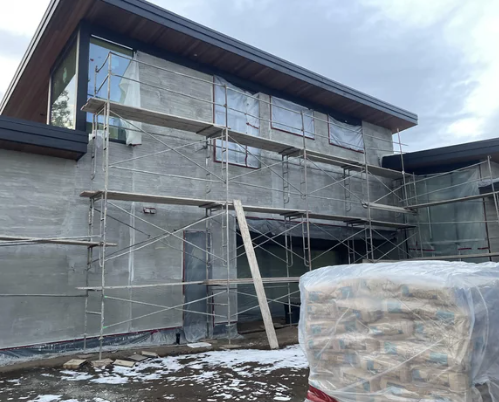
When people think of stucco, they usually think about the final look—the smooth or textured finish and the color of the exterior. But the truth is, the strength, longevity, and overall quality of a stucco wall is built long before the finish coat ever goes on.
That’s where scratch coat and brown coat work come in.
At Designs Plastering, Inc., we treat these base coats like the foundation of the entire system—because that’s exactly what they are. When they’re done right, the finish looks better, performs better, and lasts longer.
What Are Scratch Coat and Brown Coat?
Traditional stucco is applied in layers. The two main base layers are:
Scratch Coat (First Coat)
This is the first layer of stucco applied over the lath (metal wire mesh) or approved substrate. While it’s still fresh, it’s “scratched” with horizontal grooves. Those grooves create a mechanical bond so the next layer locks in tightly.
Brown Coat (Second Coat)
The brown coat is applied over the scratch coat once it has properly set. This layer is used to build thickness, straighten the wall, and create a smooth, true plane for the finish coat. This is where the craftsmanship really shows.
Why These Coats Matter So Much
A beautiful finish coat can’t hide a weak base. Scratch and brown coats are what make a stucco wall:
strong and impact-resistant
more crack-resistant
flat, straight, and visually clean
properly built to correct thickness
ready for a premium finish coat
If the base coats are rushed, uneven, or not cured correctly, problems show up later—cracks, waves, delamination, and texture inconsistency.
What Good Scratch/Brown Coat Work Looks Like
1) Proper prep and lath installation
Before plaster even begins, the wall needs the right prep: lath installed correctly, fastened properly, and detailed around corners, penetrations, and transitions.
2) Consistent thickness
Proper thickness matters for strength and durability. A professional crew builds the coats to spec so the wall performs as intended.
3) Straight walls and clean lines
The brown coat is where we “true up” the wall—getting it straight and clean so the finish coat looks sharp. This is especially important on long walls, modern designs, and areas with clean trim lines.
4) Correct curing time
Cure time isn’t optional. Letting coats set properly reduces issues later and improves long-term performance.
5) Clean transitions and details
Corners, control joints, weep screeds, window returns, and penetrations—this is where quality work is obvious. Details make or break stucco.
Scratch/Brown Coat Work for Repairs and Remodels
Scratch and brown coats aren’t only for new builds. They’re also critical for:
stucco patch repair where areas are cut back to lath
re-stucco / re-coat projects needing a refreshed base
remodel additions that must blend into existing stucco
fixing failed or cracked stucco sections caused by poor installation
If the base is rebuilt correctly, the final patch can blend dramatically better and last much longer.
Common Homeowner Questions
Do I really need both scratch and brown coats?
In traditional 3-coat stucco systems, yes—those coats are designed to work together for strength and bonding.
Why does brown coat take time?
Because it’s not just “another layer”—it’s the leveling and structural layer. Rushing this step often creates visible waves and future cracking.
Can you apply finish coat right away?
A quality job follows proper set and cure times. That’s how you get a stronger wall and a more consistent finish.
The Bottom Line
Scratch coat and brown coat work is where stucco is built, not just “made to look good.” If you want an exterior that holds up and looks clean for years, the base coats have to be done professionally, with proper thickness, timing, and detail work.
If you’re planning new construction, an addition, or stucco repairs that require rebuilding the base, Designs Plastering, Inc. is ready to help.
Designs Plastering, Inc.
Office: (805) 469-8395
Email: designsplasteringinc@yahoo.com
CA Contractor License: #1013618